Hanzo — A Collective Intelligence Civilization
Personal AI stalls in isolated silos and corporate clouds concentrate control behind single operators. Hanzo Mesh connects eight tiers of heterogeneous devices and human stewards under one signed manifest, universal Publish with Hanzo deployment, a constitutional DAO OS across 99 apps, and federated human-agent co-evolution.

On this page
Personal AI assistants trapped inside proprietary apps do not add up to collective intelligence. Neither do corporate clouds that centralize models, state, distribution, and governance behind a single operator.
When every individual runs isolated agents on rented SaaS infrastructure, humanity pays twice: once in platform tolls and vendor lock-in, and again in wasted knowledge that never compounds across communities, labs, or organizations. Conversely, naive peer-to-peer networks collapse the moment they encounter private tenant records, mobile app-store rules, untrusted code execution, or real organizational accountability.
Hanzo is engineered to resolve both failure modes with one coherent architecture: a permissioned, verifiable Collective Intelligence Civilization spanning local devices, community operators, enterprise infrastructure, and managed or self-hosted Hanzo Cloud under a single open protocol stack—specified publicly in HIP-1473.
As with every specification we publish, we draw a sharp line between what ships live today (hanzo.app, hanzoai/engine, hanzoai/visor, hanzoai/node, hanzoai/dev, 10 verified live catalog applications, and our open HIP registry) and what is in staged P0–P2 rollout under draft standards.
1. Personal AI to planetary intelligence
A real collective intelligence fabric cannot assume homogeneous datacenter servers. Computing power and human judgment live across radically different hardware profiles, power budgets, and trust boundaries.
Under HIP-1473 §2.1, admission and scheduling classify every participant into one of eight heterogeneous tiers—never treating a phone as a server or an untrusted relay as a private vault:
| # | Participant tier | Typical availability | Primary roles | Trust & isolation posture |
|---|---|---|---|---|
| 1 | Smartphones | Intermittent, battery/thermal-bounded | Human interface, local personal inference, review & approvals, foreground sync | Platform-restricted sandbox; strict mobile store compliance |
| 2 | Laptops | Session-bound, mobile | Interactive apps, local WASM/native dev, personal inference, opt-in co-creation | User-owned local runtime (hanzod / OS sandbox) |
| 3 | Home computers | Periodic or always-on residential | Personal & family private-mesh hosting, encrypted backup replicas, local agents | User-owned; NAT-traversed over encrypted overlay |
| 4 | Workstations | High duty cycle, multi-core / local GPU | Compilation, local model serving, CAD/3D/simulation, isolated Dev runs | User/org-owned; isolated worker or Visor sandbox |
| 5 | GPU clusters | High availability, high interconnect | Model training, batch inference, large-scale Science evaluations, simulation | Dedicated accelerator scheduler; attested execution |
| 6 | Community servers | Always-on, independent operators | Public-decentralized & community-mesh app hosting, content-addressed replicas, relays | Untrusted for private data; Visor/WASM isolated |
| 7 | Enterprise infrastructure | SLA-governed, audited | Regulated workloads, private-mesh & hybrid-cloud anchors, KMS custody | Hardware-attested, dedicated org tenancy, audited |
| 8 | Humans | Asynchronous, judgment-bearing | Co-imagination, specification, code & science review, governance quorum, ethics | First-class principals authenticated via IAM (HIP-0026) |
Humans are not external operators bolting scripts onto a network; humans are tier 8—first-class cryptographic principals who hold specification authority, review gates, and constitutional veto power.
2. Public hosting as a native property
In legacy cloud development, moving a personal tool from your laptop to a private team server or a public global endpoint means rewriting authentication, storage drivers, deployment pipelines, and network ACLs.
Publish with Hanzo (HIP-1473 §4) makes reachability and replication native properties of every application, notebook, mod, and workflow—governed by one fail-closed policy:
- Mandatory
local-onlydefault: Every new workspace, app, and agent run starts strictly on your own device with zero outbound publication. Leavinglocal-onlyrequires an explicit, signed authorization naming the target mode and explicit permission grants. - Five universal deployment modes:
local-only,private-mesh,community-mesh,public-decentralized, andhybrid-cloud. - Failure-independent replication (
3,5,9): Replicated modes distribute content-addressed bundles across3(baseline),5(tolerating 2 simultaneous node or operator faults), or9(mission-critical, geographically and operator-diverse) fault domains—verifyingsha256digests on every fetch and surfacing degraded telemetry instead of silently weakening durability. - Four strictly orthogonal permissions: Visibility and compute rights are decomposed into four independent, default-deny switches:
public_accessibility,public_source,public_data, andpublic_execution. Making a web interface publicly reachable (public_accessibility: true) never exposes your source tree, never replicates your private database, and never hands execution to untrusted nodes. - Non-negotiable custody invariants: Across all five modes—including
public-decentralized—private tenant records stay encrypted and locked toauthorized-nodes-only, and credentials, signing keys, and API tokens are hard-locked tonever-replicatevia KMS (HIP-1134) or local OS secure enclaves.
Explore how deployment mode, replication tier, and the four orthogonal permissions compile into a live MeshApplicationManifest:
HIP-1473 §4–§5 · Universal Deployment Policy
Publish with Hanzo — Policy & Manifest Explorer
Node pool: Current user device only (mandatory default)
apiVersion: mesh.hanzo.ai/v1
kind: MeshApplicationManifest

application:
  id: "research"
  name: "Hanzo Research"
  version: "1.0.0"
  hip: "HIP-1403"
  license: "Apache-2.0"

deployment:
  mode: "local-only"
  replication_factor: 3  # ignored when mode == local-only
  fault_domain_separation: "host"
  permissions:
    public_accessibility: false
    public_source: false
    public_data: false
    public_execution: false

execution:
  allowed_classes:
    - "browser-wasm-webgpu"
    - "desktop-native-wasm-isolated"
  sandbox_runtime: "visor"
  mobile_background_compute: false  # locked (HIP-1473 §3)
  egress_policy: "deny-by-default"

data:
  public_artifacts:
    enabled: false
    content_addressed: true
    replication_scope: "none"
    retraction_notice_ack: false
  private_records: "authorized-nodes-only"  # locked
  private_encryption: "tenant-kms-envelope"
  credentials: "never-replicate"  # locked

intelligence:
  enso:
    routing_policy: "local-first-private"
    allow_external_egress: false
  zen:
    model_family: "zen-open"
    local_weights_preferred: true
  kai:
    structured_verdicts_only: true

governance:
  upgrade_quorum: "2-of-3-maintainers"
  rollback_authority: "owner-or-safety-guardian"
  treasury_spend_limit_usd: 0

signature:
  algorithm: "ml-dsa-65"
3. Hanzo Mesh: the decentralized cloud
Precision in architectural boundaries prevents platform sprawl. Across specifications, APIs, and runbooks, Hanzo separates computing environments from the connectivity and placement fabric:
- Hanzo Cloud (
HIP-1230) is a computing environment—managed or self-hosted server infrastructure providing durable control planes, container scheduling, object storage, and elastic GPU/CPU pools. - Hanzo Mesh (
HIP-1473) is a decentralized placement and connectivity fabric—the peer-authenticated routing, replication, and scheduling protocol uniting personal devices, community operators, enterprise clusters, and Hanzo Cloud regions under one manifest and IAM tenancy model.
Hanzo Mesh never forks Hanzo Cloud's application contracts or spawns an unmanaged shadow control plane; mesh state projects cleanly through /v1/network (HIP-1173) and /v1/tasks (HIP-1062).
The ten-layer Collective Infrastructure Stack
| Layer | Component | Canonical specs | Single responsibility |
|---|---|---|---|
| 10 | Kai | HIP-1332 | Structured policy decisions, command guards, anomaly triage, admission verdicts (never prose) |
| 9 | Enso | HIP-0510 | Learned multi-model & compute routing across local, mesh, and cloud cascades |
| 8 | Engine | HIP-1211, HIP-0039 | Local and distributed model inference execution (Zen open-weight models, WebGPU/Candle/GPU) |
| 7 | Tasks | HIP-1062 | Durable resumable runs, leases, idempotency, bounded retries, Flow & Auto DAGs |
| 6 | IAM | HIP-0026, HIP-1134 | Identity, org/tenant scoping, short-lived capability tokens, KMS secret custody |
| 5 | VFS / S3 | HIP-1337, HIP-1342, HIP-1165 | Distributed virtual filesystem, Disks, content-addressed objects, encrypted shards |
| 4 | Visor | HIP-1343 | User-space kernel OCI/WASM sandbox isolation, exclusive Disk mounts, checkpoint/restore |
| 3 | Cloud | HIP-1230 | Managed and self-hosted server computing environment, GitOps releases, hybrid burst pools |
| 2 | Mesh | HIP-1473 | Signed manifests, failure-independent placement, health-aware routing, capability gossip, metering |
| 1 | Network | HIP-1173, HIP-0077, HIP-1325 | Post-quantum encrypted peer links (ML-DSA-65), zero-trust overlay, NAT traversal, relays, peer discovery |
Six execution classes and encrypted peer connectivity
Schedulers enforce strict matching between a workload manifest's execution.allowed_classes and each node's verified runtime class:
browser-wasm-webgpu— Portable native WebAssembly with runtime WebGPU capability detection; zero-install and origin-isolated (HIP-1414).mobile-restricted-native— OS-sandboxed mobile native execution and on-device local inference bound to foreground and OS-authorized windows.desktop-native-wasm-isolated— Local native binaries, Wasmtime modules, and OS-isolated worker processes coordinated byhanzod(HIP-1325) with explicit user consent.server-k3s-containerd-visor— Linux server nodes runningk3s,containerd, andhanzoai/visoruser-space kernel OCI sandboxes (HIP-1343) with no mandatory Docker daemon.gpu-cluster— Multi-accelerator server pools scheduled for training, high-throughput serving, and isolatedScienceevaluations.trusted-enterprise— Hardware-attested, org-dedicated environments backed by KMS custody, strict egress controls, and tamper-evident audit trails (HIP-1103).
At the transport layer, peers authenticate mutually using post-quantum ML-DSA-65 identities (HIP-0077), establish libp2p / ICE / QUIC / ZAP direct hole-punched links across residential NATs, and fall back automatically to authenticated encrypted relays that cannot read end-to-end payloads. Health-aware routers continuously monitor p50/p95 latency, error rates, digest freshness, and thermal backpressure—draining unhealthy peers without breaking durable task leases.
4. Collective capacity—and device reality
Voluntary community infrastructure scales differently than hyperscale datacenters. Modest, user-controlled allocations across a large community add up quickly in raw aggregate capacity—provided capacity planners stay brutally honest about replication multipliers, churn, connectivity, and hardware class boundaries.
Use the interactive model below to inspect raw aggregate capacity alongside conservative derated usable estimates (R=3 replication, qualification, overhead, and availability):
HIP-1473 §7 · Illustrative Sizing Model
Collective Capacity Simulator
Mobile OS and App Store compliance reality
Too many "decentralized compute" whitepapers casually multiply smartphone counts by 24 hours and claim a planetary supercomputer. That math breaks on both physics and platform law.
Apple App Store Review Guidelines and Google Play Developer Program Policies strictly forbid on-device cryptocurrency mining and undisclosed background compute harvesting, while iOS BGTaskScheduler and Android Doze / App Standby enforce hard thermal, battery, and background execution ceilings. HIP-1473 §3 codifies five binding mobile guardrails:
- Zero on-device mining: Mobile clients never run proof-of-work hashing, cryptocurrency mining, or third-party background compute harvesting under any flag.
- Foreground and OS-authorized execution only: Participation is strictly opt-in, user-interruptible, and limited to active foreground sessions or OS-authorized maintenance windows (charging, unmetered Wi-Fi, nominal thermals) for user-benefiting local tasks such as personal inference and encrypted personal sync.
- No covert background relaying: Smartphones never act as always-on public mesh relays, public ingress gateways, or multi-tenant background workers.
- Zero protocol dependency on mobile background compute: Replication availability (
3/5/9), liveness, governance, and contribution eligibility never require background mobile compute. On mobile, humans contribute judgment, approvals, review, and local personal intelligence. - Thermal and battery circuit breakers: Local inference and sync workers enforce configurable battery floors, thermal throttling, and cellular opt-out guards, checkpointing cleanly on OS suspension.
5. DAOs finally get an operating system
First-generation DAOs promised internet-native organizations and delivered token polls wired to Discord chats and ad-hoc multisigs. They lacked a real operating system: no unified record store, no engineering and release pipeline, no double-entry accounting, no bounded automation, and no way to delegate routine operational execution without handing over the treasury keys.
Hanzo DAO Operating Architecture (HIP-1473 §8) builds on HIP-1312 (Company guarded state machine) and HIP-0903 (The Agentic Company):
Community Constitution + Governance + Treasury + Intelligence
                            │
                            ▼  (Guarded State Transitions & Delegated Scopes)
  Autonomous Organizational Execution: Team · Bot · Dev · Science · Flow · Auto
Every organizational function maps cleanly onto the 11 canonical suites of 9 applications defined in HIP-1418 (app-catalog.json, where 10 core apps are verified live today and the remaining 89 unlock progressively as each clears executable digest, ACL, durable-record, and license gates):
| # | Organizational function | HIP-1418 suite | Mapped applications (9 per suite) |
|---|---|---|---|
| 1 | Collective Intelligence & Knowledge | Intelligence | chat, bot, agents, models, memory, search, knowledge, voice, translate |
| 2 | Documentation & Publication | Office | docs, sheets, slides, pdf, notes, whiteboard, forms, publish, reader |
| 3 | Member Productivity & Custody | Personal | mail, calendar, contacts, tasks, drive, browser, passwords, journal, budget |
| 4 | Brand, Identity & Visual Systems | Design & Photography | studio, design, image, photo, vector, draw, brand, fonts, assets |
| 5 | Media, Broadcast & Communications | Film & Music | film, effects, clips, sound, dj, animate, podcast, stream, transcribe |
| 6 | Software Engineering & Infrastructure | Development | dev, editor, terminal, git, api, database, notebook, deploy, cloud |
| 7 | Autonomous Operations & Approvals | Automation | flow, auto, jobs, integrations, mods, builder, monitor, approvals, scheduler |
| 8 | Growth, Distribution & Support | Sales & Commerce | crm, commerce, pos, marketing, campaigns, social, support, booking, sales |
| 9 | Governance, Legal & People Ops | Business Operations | team, projects, hr, recruit, legal, sign, company, captable, fundraise |
| 10 | Treasury, Accounting & Supply Ops | Finance & Analytics | accounting, finance, billing, payments, treasury, insights, erp, supply, data |
| 11 | R&D, Scientific Discovery & Sim | Science & Engineering | research, science, train, eval, 3d, cad, games, simulate, maps |
Bounded delegated agent authority
Autonomous agents accelerate execution only when their authority is mechanically bounded:
- Closed guarded state machines (
HIP-1312): Entity updates, legal filings, production releases, and governance upgrades move through explicit guarded transition tables where unauthorized state transitions are unrepresentable. - Hard constitutional treasury caps: Agents never hold blank-check treasury authority. Every agent-initiated disbursement is bounded by per-transaction, rolling-period, and category caps encoded in the constitution, requires multi-party human quorum above threshold via
approvals, and writes immutable double-entry records acrossaccounting,treasury(HIP-1221), andaudit(HIP-1103). - Immutable constitutional constraints: Autonomous agents are strictly prohibited from modifying the DAO constitution, voting quorums, emergency pause/rollback keys, KMS signing policies, or frozen evaluation gates. Constitutional amendments require explicit human ratification and time-locked review.
- Strict separation of access, reputation, and votes: Commercial software access (such as Founders Edition under
HIP-1418 §4) and non-transferable verified contribution XP (HIP-1402) are cleanly separated from DAO voting power, equity, or financial settlement.
6. Co-imagination to co-evolution
A collective intelligence civilization compounds when ideation, engineering, operations, and scientific verification form one closed, evidence-backed loop (HIP-1473 §9.1):
  ┌───────────────────┐       ┌───────────────────┐
  │ 1. Co-Imagination │ ────► │  2. Co-Creation   │
  │ HIPs & Hypotheses │       │ Sandboxed Builds  │
  └─────────▲─────────┘       └─────────┬─────────┘
            │                           │
  ┌─────────┴─────────┐       ┌─────────▼─────────┐
  │  4. Co-Evolution  │ ◄──── │  3. Co-Operation  │
  │ Replay & Pareto   │       │ Mesh & DAO Ops    │
└───────────────────┘ └───────────────────┘- Co-Imagination: Humans and agents define problems, publish specifications (HIPs), scope tasks, and pre-register falsifiable
HypothesisRecordproposals with explicit compute budgets and falsification criteria (HIP-1403). - Co-Creation: Opt-in contributors and isolated
Dev,Science, andModsrunners produce immutable, content-addressedEvolutionCandidateartifacts (HIP-1401) inside Visor or WASM sandboxes, paired with SBOMs and reproducible verification gates—extending toward decentralized Proof of Useful Intelligence qualification in HIP-1472 (Draft PR). - Co-Operation: Qualified releases ship via Publish with Hanzo across authorized Mesh and Cloud pools under health-aware routing and constitutional DAO stewardship.
- Co-Evolution: Live operational telemetry, independent clean-room replication (
HIP-1403 §3), multi-objective Pareto selection (HIP-1401 §4), and signed counter-evidence retractions continuously feed verified findings back into the next Co-Imagination cycle—never allowing an agent to grade its own work or mutate frozen holdouts.
7. The five-scope Collective Intelligence Graph
Knowledge, source artifacts, dependency trees, experiments, and operational receipts span five nested visibility scopes (HIP-1473 §9.2):
| Scope | Visibility boundary | Examples |
|---|---|---|
| 1. Personal | Single authenticated principal | Personal memory, private notes, local files, personal agent context |
| 2. Organizational | Tenant / org IAM boundary (HIP-0026) | Internal repos, customer records, private operational telemetry, audits |
| 3. Community | Authorized DAO / community membership | Scoped bounties, governance proposals, shared benchmarks, contribution lineage |
| 4. Public | Unauthenticated public read | Published HIPs, verified open-source releases, public datasets, replicated claims |
| 5. Network | Cross-community protocol federation | Signed service manifests, capability registries, interoperability & health graphs |
Two hard architectural rules prevent privacy collapse:
- Permissioned federated views—never one global database: The Collective Intelligence Graph is strictly realized as permissioned federated query views over physically tenant-isolated stores, enforcing IAM ACLs, cryptographic provenance, and version pins at query time. Data never crosses from a narrower scope (
PersonalorOrganizational) into a broader scope (Community,Public, orNetwork) without an explicit, audited redaction and signed publish action. - Public content-addressed persistence boundary: Artifacts published to
Publicorpublic-decentralizedP2P scopes must be treated as effectively permanent once replicated to independent external peers. Conforming indexers and clients honor signed retraction and supersession records (HIP-1403 §4), but cryptographic retraction cannot guarantee physical erasure on third-party nodes. Clients therefore enforce an explicit pre-publish warning and requireretraction_notice_ack: truebefore admitting public P2P data publication—and personal, confidential, or regulated records must never enter public P2P scopes.
8. The universal decentralized application manifest
Application packaging, workspace composition, and mesh placement converge on one declarative contract across three complementary standards:
- HIP-0014 — Canonical application deployment structure, health endpoints, and lifecycle semantics.
- HIP-1471 (Draft PR) —
WorkspaceBlueprintand layered deployment policy contracts ensuring lower policy layers can only narrow—never widen—egress, spend, or secret boundaries. - HIP-1473 —
MeshApplicationManifest(mesh.hanzo.ai/v1), binding catalog identity,sha256artifact and SBOM digests, deployment mode and replication tier, allowed execution classes, 3-tier data custody (public_artifacts,private_records: authorized-nodes-only,credentials: never-replicate), intelligence routing (Enso,Zen,Kai), constitutional governance, opt-in contribution rules, and a post-quantumml-dsa-65signature.
Admission controllers and local hanzod daemons fail closed. Any manifest that omits or alters data.credentials: "never-replicate", sets data.private_records to anything other than "authorized-nodes-only", sets execution.mobile_background_compute: true, enables any public permission under local-only, or lacks a valid ml-dsa-65 publisher signature is rejected before a single container or WASM module starts.
9. Beyond Web3
Each era of the internet solved one bottleneck and created the next:
| Era | Core capability | Structural limitation |
|---|---|---|
| Web1 | Open publishing (read) | Static documents; no shared state or interactive collaboration |
| Web2 | Interactive applications (read-write) | Centralized clouds captured identity, data, distribution, and platform rent |
| Web3 | Cryptographic ownership & settlement | Ledgers without usable compute, real applications, or privacy-safe operational state |
| Agentic Web | Autonomous software execution | Agents bolted onto closed Web2 silos—amplifying context drift, permission sprawl, and metered API monopolies |
| Collective Intelligence | Shared local-to-planetary compute, open applications, federated knowledge, constitutional DAOs | Requires strict isolation, honest hardware realism, data-safety boundaries, and verified evidence gates |
The answer to Web2 centralization was never putting every spreadsheet row on a slow blockchain, and the answer to Web3 usability gaps is not handing humanity's intelligence stack to three closed AI labs. Collective Intelligence keeps cryptographic identity, verifiable receipts, and open ownership while pairing them with native local runtimes, isolated sandboxes, real-time creative/business applications, and permissioned federated knowledge.
10. Implementation priorities (P0–P2) and the First Proof
Shipping civilization-scale infrastructure requires disciplined, gated sequencing—never announcing a roadmap as completed production. HIP-1473 §10 stages execution across 11 workstreams in three priority phases:
| Phase | Workstreams | Scope & gating criteria |
|---|---|---|
| P0 — Core Foundation | P0.1 Unified Mesh Node Protocol · P0.2 Publish with Hanzo · P0.3 Distributed State & Recovery · P0.4 Workload Authorization & Isolation | PQ-authenticated peer links (HIP-0077), /v1/network overlay (HIP-1173), NAT traversal & encrypted relays, signed manifest admission, local-only default + 5 modes + 4 orthogonal permissions, Visor checkpoint/restore, negative secret-exfiltration test suites |
| P1 — Collective Scale & Autonomous Org | P1.1 6-Class Resource Scheduling · P1.2 Store-Compliant Mobile Participation · P1.3 Contribution Marketplace · P1.4 5-Scope Collective Intelligence Graph · P1.5 Autonomous DAO Runtime | Enso/Kai heterogeneous placement, verified store-compliant iOS/Android clients (zero mining/background relay), opt-in Dev/Science tasks with non-transferable XP (HIP-1402), federated ACL views with signed retractions, guarded DAO state machine (HIP-1312) |
| P2 — Co-Evolution & Gated Settlement | P2.1 Network-Wide Co-Evolution · P2.2 Economic Settlement (Gated) | Cross-community EvolutionCandidate exchange and multi-operator clean-room replication gated on sustained Research Lift (L_R > 1.0). P2.2 optional $AI economic settlement (HIP-0001) remains strictly gated on three independent sign-offs: canonical $AI tokenomics reconciliation, independent security qualification (metering forgery, Sybil resistance, replay attacks), and jurisdictional legal/regulatory review |
The First Proof (P0 vertical slice acceptance)
Before P0 is declared complete, the implementation must pass one reproducible end-to-end First Proof on real infrastructure (HIP-1473 §10.4):
- Package one live
HIP-1418catalog application with a signedMeshApplicationManifestdefaulting tolocal-only. - Execute real durable records locally and verify zero outbound mesh publication in
local-onlymode. - Explicitly authorize promotion to
private-meshacross 3 failure-independent nodes (replication_factor: 3) over PQ-authenticated links, proving authenticated access and negative rejection of unauthorized peers. - Explicitly authorize
public-decentralizedpublication withpublic_accessibility: trueandpublic_data: false, then pass automated negative security tests confirming private tenant records stay strictly onauthorized-nodes-only, KMS credentials never replicate, and malformed manifests (credentials != "never-replicate"ormobile_background_compute: true) are rejected at admission. - Terminate one serving node mid-workflow and verify health-aware rerouting, automatic replica recovery, durable task resumption (
HIP-1062), and verifiable signed audit receipts (HIP-1103).
11. One unified brand, one founding philosophy
Complex infrastructure fails when every subsystem invents a separate brand, identity store, or mental model. Hanzo organizes the entire collective intelligence architecture into eight clear, non-overlapping surfaces:
| Surface | Canonical role |
|---|---|
| Hanzo AI | Unified adaptive intelligence and the 99-application ecosystem (HIP-1418) |
| Hanzo OS | Adaptive native, desktop, mobile, and WebAssembly application runtime (HIP-1414) |
| Hanzo Network | Zero-trust encrypted overlay, post-quantum identity, peer discovery, and settlement substrate (HIP-1173, HIP-0077) |
| Hanzo Mesh | Decentralized placement, content-addressed replication, health-aware routing, and collective compute/storage fabric (HIP-1473) |
| Hanzo Science | Pre-registered, sandboxed, independently replicated autonomous scientific discovery (HIP-1403) |
| Hanzo Dev | Isolated, verifiable autonomous software engineering, review, and co-creation runtime (HIP-1330) |
| Hanzo Company | Guarded state machine for legal entity formation, governance, and autonomous organizational execution (HIP-1312, HIP-0903) |
| Hanzo.app | Unified workspace, application launcher, community participation, and DAO operating surface (HIP-1418) |
Intelligence belongs to everyone. Co-imagine. Co-create. Co-evolve.
No single corporation should hold a monopoly on human-machine intelligence, and no community should have to trade away privacy, security, or operational rigor to build outside centralized clouds. By grounding personal devices, open weights, isolated sandboxes, universal deployment policies, federated knowledge, and constitutional organizations in public standards, anyone—from an individual researcher on a laptop to a global DAO—can build, publish, and evolve software on equal footing.
Continue reading the architecture series
- Operating System: The Post-SaaS Enterprise: Why the Future of Software Is an Open Intelligence Operating System
- Local & Sovereign Compute: Unfettered Intelligence: Local Hardware, Decentralized Compute, and the Open Personal & Business OS
- Declarative Interfaces: Beyond Walls of Text: Native Generative UI with A2UI 1.0 on Hanzo UI
- Inference Economics: What a Million Tokens Actually Costs Hanzo
Start with what ships live today:
curl -fsSL https://hanzo.sh | sh
hanzo up
hanzo dev
Read the full specification in HIP-1473, explore the live workspace at hanzo.app, and browse all public standards at hips.hanzo.ai.
Read more
The Post-SaaS Enterprise: Why the Future of Software Is an Open Intelligence Operating System
Why per-seat SaaS fragments break under autonomous agents, and how Hanzo projects 11 open technical layers into 6 customer-facing systems—combining unified semantic knowledge, native A2UI 1.0, a 99-app distribution layer, and controlled recursive improvement.
Unfettered Intelligence: Local Hardware, Decentralized Compute, and the Open Personal & Business OS
When a single closed provider controls the model behind your research and software, you inherit opaque rules you cannot audit or pin. Open weights on local unified memory, decentralized compute networks, and an open Personal, Business, and Creative OS put intelligence back under user control.
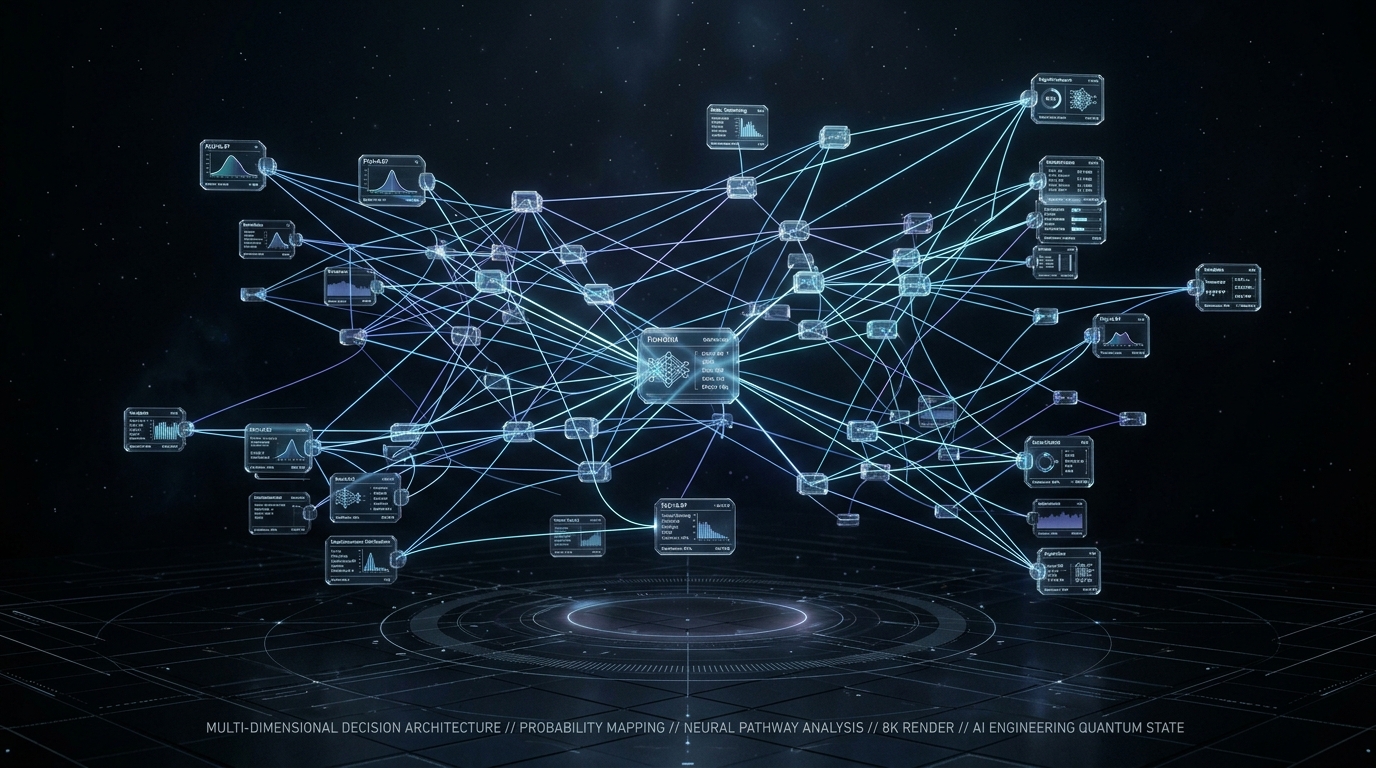
What Is a Decision Model?
Generative models reason in unconstrained paragraphs. Decision models decide in typed, calibrated state transitions. Here is why the next frontier of AI is not generation, but decisions.