The Post-SaaS Enterprise: Why the Future of Software Is an Open Intelligence Operating System
Why per-seat SaaS fragments break under autonomous agents, and how Hanzo projects 11 open technical layers into 6 customer-facing systems—combining unified semantic knowledge, native A2UI 1.0, a 99-app distribution layer, and controlled recursive improvement.

On this page
Enterprise software spent twenty years splitting organizations into fifty disconnected databases and calling it "best of breed."
Your customer records live in one SaaS vendor's schema. Your wiki lives in another's. Your tickets, billing ledgers, creative files, analytics events, and approval workflows sit in six more—each with its own login boundary, its own permission model, its own webhook glue, and its own per-seat subscription tax. Humans papered over those seams by copying links between browser tabs.
Autonomous agents expose how broken that architecture is. Give an agent real operational work inside a fragmented SaaS stack and four failures hit immediately:
- Context drift: The team wiki, the CRM, and the agent's vector memory hold three incompatible copies of reality.
- Permission sprawl: Every app invents its own roles, API keys, and audit trail, making least-privilege enforcement impossible.
- UI dead ends: Agents either dump walls of markdown into a chat box or try to click brittle SaaS DOM trees built for human eyeballs.
- Misaligned economics: Per-seat pricing and flat monolithic LLM APIs were never designed for hybrid human-and-agent workloads.
Bolting a sidebar chatbot onto forty closed SaaS apps does not fix this. Neither does building one more monolithic AI app. The post-SaaS enterprise needs an Open Intelligence Operating System—one shared contract for identity, records, semantic knowledge, models, tools, durable execution, declarative UI, and verified improvement, deployable on local hardware, in a browser, on your own cluster, or on sovereign cloud.
Here is the complete architecture we are building and shipping across hanzoai/hips (HIP-0000 and HIP-1400 through HIP-1418) and our public repositories—with a crisp line between what is live today and what is in progressive beta and active standard rollout.
1. Eleven technical layers, projected into six customer-facing systems
An operating system has to be decomplected underneath so engineers can swap kernels, models, and runtimes without rewriting applications—yet legible on the surface so people and organizations adopt coherent systems rather than raw plumbing.
Hanzo's architecture separates cleanly into 11 technical layers, each governed by owning HIPs and a single authority (no duplicate identity stores, no competing workflow engines, no brand-forked UI kits):
| # | Technical layer | Canonical contracts & repositories | Single responsibility |
|---|---|---|---|
| 1 | Specification & Conformance | hanzoai/hips, HIP-1400 (standard.json), HIP-0139 | Machine-readable spec manifest, SemVer contracts, deterministic conformance gates |
| 2 | Sovereign Compute, Runtime & Sandbox | hanzoai/os (HIP-1414), hanzoai/visor (HIP-1172/HIP-1343), hanzoai/node (HIP-1325), HIP-0121 | Native, Web/WASM, optional Linux compatibility guest, Edge, Network, and isolated Visor sandboxes |
| 3 | Identity, Tenancy & Secret Perimeter | hanzo.id IAM (HIP-0026/HIP-0519/HIP-0527), Hanzo KMS | One identity boundary, strict Personal vs. Business workspace isolation, hardware-backed secrets |
| 4 | Structured Records, Files & Vector Storage | hanzoai/base (HIP-1104), hanzoai/vfs/s3 (HIP-1337/HIP-1342), hanzoai/datastore | Tenant-isolated records, workspaces, durable files, and shared vector namespaces |
| 5 | Unified Semantic Graph & Knowledge | /v1/knowledge (HIP-1260), /v1/graph (HIP-1198), /v1/memory (HIP-0526), /v1/search (HIP-1147) | One document store for human wikis + agent memory, paired with a provenance-bearing assertion graph |
| 6 | Model Serving, Routing & Decisions | hanzoai/engine (HIP-0043), Zen (HIP-0039/HIP-0904), Enso (HIP-0510), Kai (HIP-1332) | Local/cluster Rust inference, open-weight checkpoints, adaptive cost-aware routing, structured decisions |
| 7 | Typed Tool & Protocol Plane | HIP-0300 Unified MCP, 19 canonical domain tools, ZAP transport | One typed tool surface shared identically by humans, CLIs, IDEs, and autonomous agents |
| 8 | Agent Harness & Durable Execution | hanzoai/kata, hanzoai/gen (HIP-1210), hanzoai/flow (HIP-1064), hanzoai/tasks (HIP-1062), hanzoai/auto (HIP-1063) | Checkpointed agent loops, visual flow graphs, durable background runs, and event triggers |
| 9 | Cross-Platform Design Substrate & Generative UI | @hanzo/gui + @hanzo/ui (HIP-0504), A2UI 1.0 (HIP-1415) | One token-driven component library across web/native/desktop + declarative zero-trust generative UI |
| 10 | Application Shell, Mods & 99-App Catalog | hanzoai/app (HIP-0528), HIP-1418 (11 suites × 9 apps) | Editable personal, business, creative, engineering, and scientific apps over shared backend records |
| 11 | Evidence, Autonomous Science & Controlled Evolution | hanzoai/audit (HIP-1103), hanzoai/research (HIP-1334), HIP-1105, HIP-1401..1403 | Tamper-evident audit trail, frozen evaluation gates, evolutionary lineage, non-transferable XP, clean-room replication |
Customers do not buy eleven plumbing layers. Those eleven layers project cleanly into six customer-facing systems:
  11 Technical Layers                     6 Customer-Facing Systems
  ───────────────────────────────────     ─────────────────────────────────────
  [4, 5] Storage + Knowledge + Graph  ──► 1. Hanzo Knowledge
  [6, 7, 8] Models + MCP + Durable    ──► 2. Hanzo Autonomous
  [9, 10] UI/A2UI + Shell + 99 Apps   ──► 3. Hanzo Applications
  [1, 11] Spec + Research + Evolution ──► 4. Hanzo Science
  [3, 4, 10] IAM + Base + Biz Suites  ──► 5. Hanzo Business Infrastructure
  [2, 6] OS Runtime + Visor + Engine  ──► 6. Hanzo Sovereign Infrastructure
Each of those six systems resolves a structural failure of the SaaS era.
2. Hanzo Knowledge: /v1/knowledge + /v1/graph without dual-store drift
Most "enterprise AI knowledge" products fail because they maintain a human wiki in one store, an agent memory table in another, and a brittle ETL script copying stale edges into a graph database.
Hanzo splits this along one crisp architectural boundary defined in HIP-1260 (/v1/knowledge, GA) and HIP-1198 (/v1/graph, alpha):
Is the edge already written in a record the tenant holds, or did somebody claim it?
/v1/knowledge(HIP-1260): Human wiki pages, agent memories, and connector-ingested documents (Slack threads, vaults, docs) are one document store indexed once into that organization's physically isolated vector namespace. A page's parent link or wikilink is a projection computed at read time (GET /v1/knowledge/graph)—never copied into a second edge table that can disagree after a rename or deletion. Indexing is fail-open (saving a document never blocks on embedding) and search is fail-honest (returningdegraded: truerather than fabricating hits)./v1/graph(HIP-1198): Owns the edges a document projection cannot answer—assertions. Who claimed this relation, from what evidence, when did it become knowable, what was the answer last Tuesday, and which two sources currently disagree?graphstores provenance, time axis, and visible conflict, and is strictly forbidden from storing documents or duplicatingknowledge's render projections.
When a human updates a design doc and an agent queries /v1/knowledge, both read the exact same source of truth under the exact same principal.Acting tenant boundary.
3. Hanzo Autonomous: bounded agency with honest economics
Agents become genuinely useful only when they share the same typed tools, permissions, and durable state as humans—without running an unconstrained cloud bill.
- One typed tool plane (
HIP-0300): Unified MCP exposes 19 canonical domain tools (fs,exec,code,git,fetch,workspace,browser,computer,ui,kai,think,plan,memory,tasks,tracker,coding,research,skills,hanzo) over one authenticated contract. Agents cannot silently invent side-channel capabilities. - Durable execution (
HIP-1062/HIP-1063/HIP-1064):Flowauthors workflow graphs,Tasksowns durable checkpointed runs that survive process restarts and laptop sleeps, andAutoowns event triggers. None of them forks the others' state. - Cost-aware routing (
Enso) + structured decisions (Kai): As detailed in What a Million Tokens Actually Costs Hanzo, Enso's per-thread adaptive router (adaptive_route.go) shifts routine tool continuations down toenso-flashwhile escalating dynamically on repeated build failures or user pushback—protected by a hard 4-class Margin Guard.
4. Hanzo Applications: native A2UI 1.0 and the 99-app distribution layer
Software interfaces should neither be frozen quarterly SaaS forms nor insecure LLM-generated HTML iframes.
Built on @hanzo/gui and @hanzo/ui (HIP-0504)—one cross-platform component library defined once and themed across brands—Hanzo ships native A2UI 1.0 (HIP-1415) across @hanzo/ui/a2ui, hanzoai/gen's Rust render_ui MCP tool, and hanzo.app. Agents emit declarative JSONL referencing your audited component catalog, bind state via RFC 6901 JSON Pointers, enforce zero-trust action.event.context submissions, and compile live surfaces deterministically into clean @hanzo/ui TSX via <A2UIWorkbench /> (read the full wire walkthrough in Beyond Walls of Text: Native Generative UI with A2UI 1.0).
Above that UI substrate sits the 99-application distribution catalog specified in HIP-1418: 11 suites of 9 applications spanning AI core (Chat, Bot, Agents, Models, Memory, Search, Knowledge, Voice, Translate), Productivity (Docs, Sheets, Slides, PDF, Notes, Whiteboard, Forms, Publish, Reader), Personal (Mail, Calendar, Contacts, Tasks, Drive, Browser, Passwords, Journal, Budget), Creative & Audio (HIP-1406..1413: Studio, Design, Image, Film, Effects, Clips, Sound, DJ, Audio, plus Photo, Vector, Draw, Brand, Fonts, Assets, Animate, Podcast, Stream, Transcribe), Engineering, Business Operations (CRM, Sales, Projects, HR, Recruit, Fundraise, Finance, Billing, ERP, Supply, Data), and Science & Simulation (Research, Science, Train, Eval, 3D, CAD, Games, Simulate, Maps).
We enforce strict release honesty in HIP-1418 §1 and §4—no pretending a roadmap is already shipped:
- Verified
livetoday (10 applications):chat,bot,studio,design,dev,terminal,flow,team,research, andscience—each backed by live routes onhanzo.apporhanzo.team. - Controlled
/betaprogressive unlock (89 applications): Remaining entries inapp-catalog.jsonare explicitly labeledbetaand unlocked progressively (initial_picks: 3,daily_unlock_rate: 1, gated by per-principal flagsbeta.<id>) only as each app clears its executable artifact digest, access-control tests, real durable-record task checks, and permissive OSS/SBOM license review (HIP-0074,HIP-0137). - Founders Edition:
$99one-time for a named user's perpetual first-party application access (personal and commercial use, updates, and future first-party apps as released), explicitly separate from metered hosted inference, GPUs, storage, and additional organization seats.
5. Business Infrastructure & Sovereign Infrastructure: one OS, strict workspace boundaries
Under HIP-1414, Personal OS and Business OS are scoped workspace profiles of the same shell, identity, and component contract—not two incompatible operating systems. Switching between personal and business scopes invalidates prior client state and re-resolves IAM permissions (hanzo.id); no agent may merge personal and business memory, files, secrets, billing, or automations without explicit user authorization.
Beneath both profiles sits Hanzo Sovereign Infrastructure:
- Browser-first native execution (
HIP-1414§2): First-party web apps compile reusable Rust engines directly to WebAssembly with WebGPU andAudioWorkletcapability detection—no mandatory Linux VM in every browser tab, and truthful degraded states instead of silent cloud fallback. An optional lazily loaded WASM Linux compatibility guest handles ARM64 Linux userspace only when needed. - Real-time local + durable async split: Live audio DSP (
HIP-1413), interactive canvases, and local open-weight inference (hanzoai/engineon Apple Silicon, GB10, and AMD Strix Halo) run locally with zero cloud jitter; heavy batch synthesis, distributed training, and long-running repo refactors execute durably across Visor sandboxes (HIP-1172), private clusters, or BYO compute fleets (HIP-0121).
6. Hanzo Science: controlled recursive improvement (HIP-1400..1403)
Most enterprise software decays over time: routing heuristics go stale, prompts drift, and nobody knows whether last month's refactor actually improved outcomes. Conversely, unconstrained "self-improving AI" is an operational hazard—an agent that can rewrite its own grader will hack the grader in ten minutes.
Hanzo's HIP-1400 through HIP-1403 stack turns improvement into an auditable engineering loop with hard security walls:
- Conformance Manifest (
HIP-1400):standard.jsonpins the exact HIP versions and layer contracts; every candidate must pass deterministic sandbox conformance before qualification. - Evolutionary Candidate Lineage (
HIP-1401): Every proposed improvement is an immutable, content-addressed, cryptographically signedEvolutionCandidate(candidate_id,parent_ids,artifact_digest,gate_ref). Evolutionary proposers may mutate explicitly permitted surfaces (harness.policy,engine.strategy,router.cascade,model.adapter,research.protocol), and are strictly forbidden from mutating:- Visor sandbox isolation and resource enforcement (
hanzoai/visor); - Frozen evaluation gates, private holdouts, or grading verifiers (
HIP-1334); - Evidence ledger write paths, signing keys, or promotion authority (
hanzoai/audit); - Normative rules in
standard.jsonwithout human governance review.
- Visor sandbox isolation and resource enforcement (
- Autonomous Scientific Research (
HIP-1403): Hypotheses are pre-registered with explicit falsification conditions and hard compute/cost budgets before confirmatory runs begin, qualified outside the candidate's authority via clean-room replay, and measured on full-cost Research Yield (Y_R). - Hanzo XP (
HIP-1402): Contribution mastery acrossharness,engine,model,sandbox,science, andspecis computed purely from immutable Evidence records—strictly non-transferable, never awarded for raw commit/token volume, and deterministically revoked if an underlying claim is retracted.
The shift ahead
SaaS turned software into rented silos. Closed AI labs tried to turn intelligence into a metered monopoly sitting on top of those silos.
An Open Intelligence Operating System collapses both rents at once: one inspectable stack from local unified-memory weights and verifiable sandboxes up through shared semantic knowledge, cost-guarded adaptive routing, zero-trust A2UI 1.0 interfaces, and an open 99-app catalog—governed by public specifications and reproducible evidence rather than vendor promises.
Read the complete technical series
- Unit Economics: What a Million Tokens Actually Costs Hanzo
- Verification Methodology: How We Benchmark Hanzo — Including What 3.02× Does Not Cover
- Model & Hardware Physics: Ternary Weights, Compression, and Efficient Intelligence
- Native Generative UI: Beyond Walls of Text: Native Generative UI with A2UI 1.0 on Hanzo UI
- Local & Sovereign Stack: Unfettered Intelligence: Local Hardware, Decentralized Compute, and the Open Personal & Business OS
Start with what ships live today:
curl -fsSL https://hanzo.sh | sh
hanzo up
hanzo dev
Explore the live workspace at hanzo.app, inspect the public standards at hips.hanzo.ai, and audit our benchmarks at hanzo.ai/benchmarks.
Read more
Hanzo — A Collective Intelligence Civilization
Personal AI stalls in isolated silos and corporate clouds concentrate control behind single operators. Hanzo Mesh connects eight tiers of heterogeneous devices and human stewards under one signed manifest, universal Publish with Hanzo deployment, a constitutional DAO OS across 99 apps, and federated human-agent co-evolution.
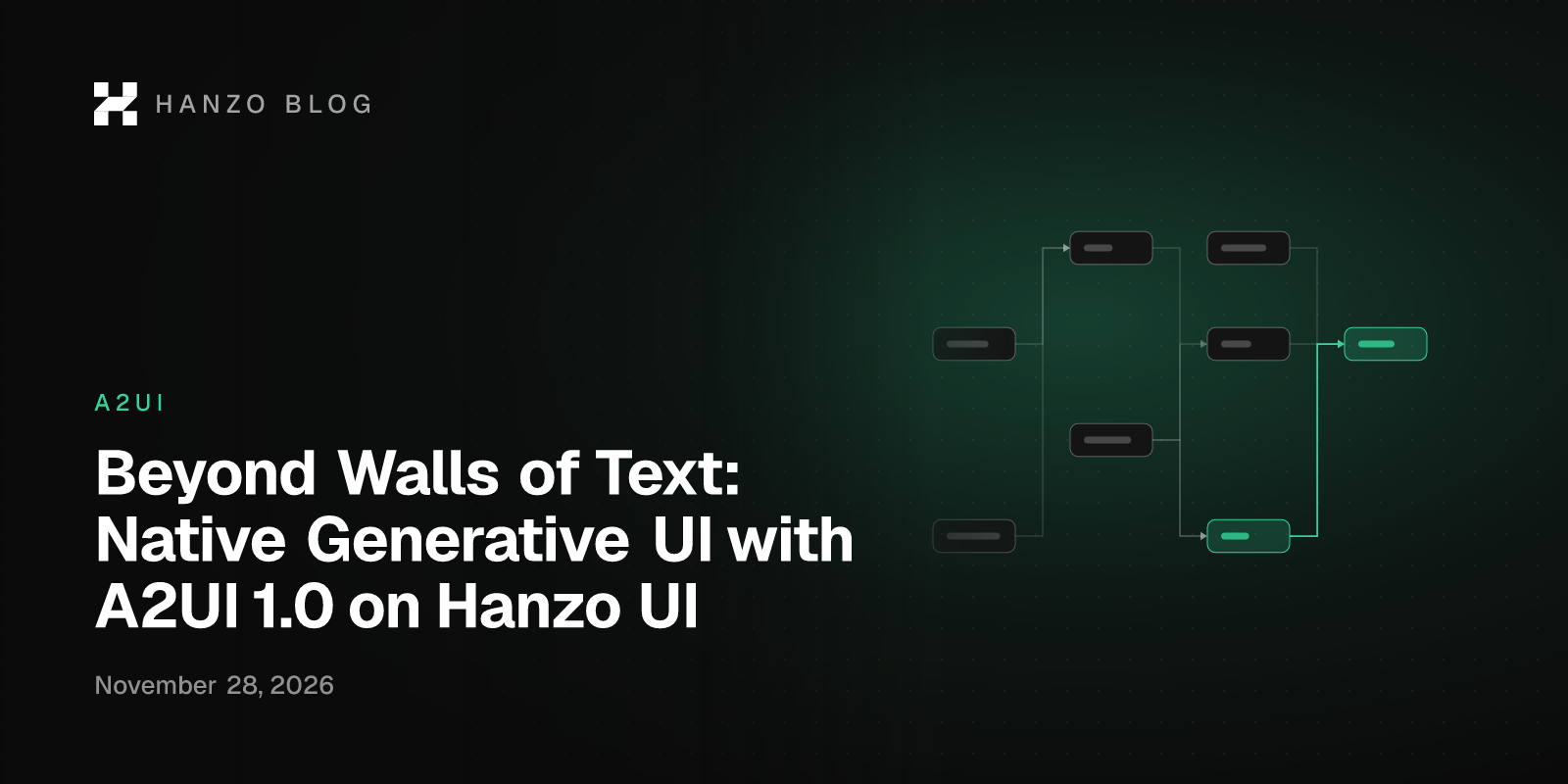
Beyond Walls of Text: Native Generative UI with A2UI 1.0 on Hanzo UI
Since 2021, Hanzo built one cross-platform UI substrate. Google's A2UI 1.0 standard validates that exact architecture: agents emit declarative JSONL surfaces rendered by your trusted @hanzo/ui catalog—no raw HTML, no eval, and zero-trust action context.
Unfettered Intelligence: Local Hardware, Decentralized Compute, and the Open Personal & Business OS
When a single closed provider controls the model behind your research and software, you inherit opaque rules you cannot audit or pin. Open weights on local unified memory, decentralized compute networks, and an open Personal, Business, and Creative OS put intelligence back under user control.